The rapid integration of the Internet Of Things In Healthcare into clinical environments is fundamentally reshaping patient safety and operational efficiency, yet it introduces complex security and management challenges that every healthcare professional must navigate. This article provides a comprehensive, evidence-based guide to the practical applications of IoMT, ensuring you are equipped to leverage these connected systems while effectively mitigating the associated risks to data integrity and patient care. By mastering these insights, you will be better prepared to implement and oversee secure, high-performance healthcare monitoring solutions in your professional practice.
Internet of Things in healthcare
The Evolution of Medical Connectivity
The Internet of Medical Things (IoMT) is revolutionising the medical sector by interlinking clinical systems, wearable technology, and medical hardware via the internet. This digital ecosystem facilitates constant remote patient observation, the preemptive identification of health complications, efficient monitoring of hospital equipment, and the automation of drug administration. These advancements are pivotal in minimising operational expenses and decreasing the frequency of patient readmissions.
Market Growth and Technological Integration
Projections indicate that the IoMT industry is set to expand to a valuation of $260 billion by 2027, with the deployment of more than 7 million integrated devices worldwide. We have officially entered the age of IoT within the medical sphere, a domain defined by the seamless fusion of intelligent sensors and connected health apparatus.
Prioritising Cybersecurity in Connected Environments
Despite the rapid expansion of IoT adoption, the resultant widening of the attack surface necessitates stringent cybersecurity protocols. A breach in a standard office peripheral is one matter, but a compromised smart infusion pump poses an immediate threat to patient safety. To protect sensitive health information, healthcare providers must implement:
- Comprehensive end-to-end encryption across all data channels.
- Rigorous identity and access management systems.
- Robust network segmentation to isolate critical infrastructure.
Enhancing Patient Outcomes and Operational Efficacy
Technological progress is continuously evolving to alleviate the pressure on modern healthcare systems, with the Internet of Things standing out as a primary catalyst for change. The implementation of these ecosystems provides substantial benefits for the 26 million individuals in the UK currently managing long-term health conditions.
Clinical Applications and Future Trends
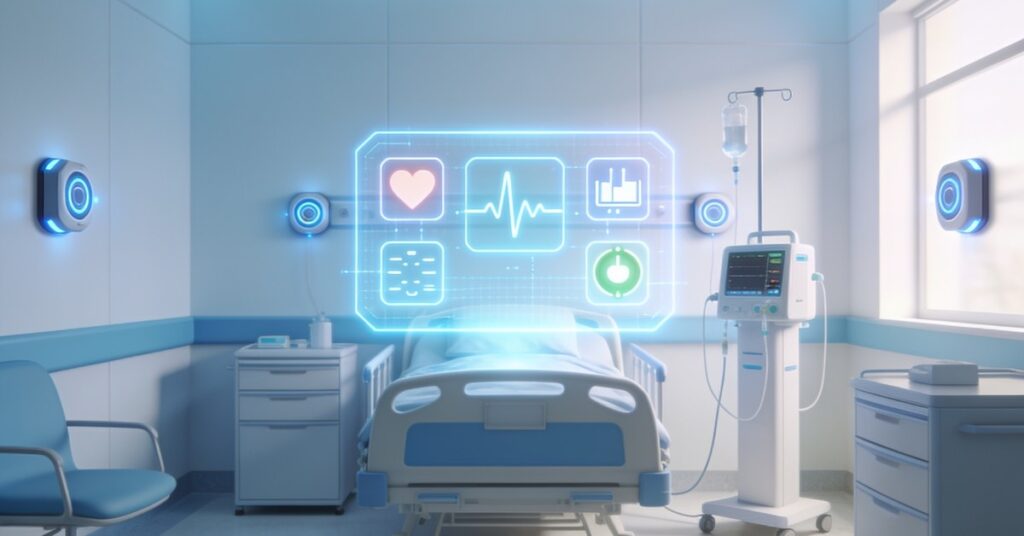
By leveraging IoT, medical facilities can facilitate shorter or fewer hospital stays, thereby shielding vulnerable patients from environmental risks and exposure to pathogens such as norovirus. Modern clinical environments are now utilising advanced infrastructure, such as AI-driven smart beds; these beds feature mattress-embedded sensors that perform real-time monitoring of patient vitals, including heart rate and respiration patterns, ensuring a high standard of precision care.
Optimising Patient Outcomes through Internet Of Things In Healthcare
The integration of the Internet Of Things In Healthcare serves as a critical mechanism for improving patient outcomes by enabling the real-time transmission of physiological data from remote patient monitoring (RPM) devices. By capturing heart rate, blood pressure, and temperature data as it happens, clinical teams can make informed decisions far more quickly than traditional episodic care allows. NHS Digital research confirms that these proactive, connected systems significantly improve resource efficiency and the overall quality of care delivered across the health service.
Beyond simple data collection, these systems are transforming clinical workflows by automating routine administrative tasks such as patient admissions and discharge processes. By integrating smart medical kits—which utilise Bluetooth stethoscopes, ECG sensors, and pulse oximeters—clinicians can perform remote diagnostics that bridge the gap between home-based care and hospital oversight. Furthermore, the technology facilitates the seamless collection of data for digital therapies, allowing providers to evaluate the cost-effectiveness of various treatment pathways with empirical precision.
Practical Applications and Healthcare Examples of Healthcare IoT
IoT in the healthcare industry functions as a foundational layer for hospital operations, providing continuous tracking of vital signs and real-time health metrics to ensure that no patient data gap exists. By deploying IoT-enabled devices for specific needs, such as tracking blood sugar levels in diabetes management, hospitals can shift from reactive care to a model of constant, data-driven support. This operational shift reduces the burden on clinical staff while maintaining high standards of patient safety.
Asset Tracking and Facility Management
Hospitals enhance operational flow by integrating RFID technologies and Real-Time Locating Systems (RTLS) to track the movement of medical equipment and patients throughout the facility. This visibility ensures that portable monitors, infusion pumps, and other critical assets are always where they are needed most, reducing wasted time and improving resource allocation. If you have ever spent twenty minutes hunting for an infusion pump during a busy shift, you know exactly how much this improves morale and efficiency.
| Feature | Traditional Tracking | IoT/RTLS Enabled |
|---|---|---|
| Location Accuracy | Manual/Logbook | Real-time (cm precision) |
| Equipment Status | Reactive repair | Predictive maintenance |
| Infection Control | Periodic manual check | Automated monitoring |
Safety and Medication Administration
Automated medication administration systems and patient identification protocols are the most effective way to reduce the incidence of preventable medical errors. By leveraging IoT connectivity, these systems ensure that the right patient receives the right medication at precisely the right time, with digital verification at every step. Additionally, predictive maintenance of medical equipment ensures that devices remain functional, preventing the clinical risk associated with unexpected hardware failure or calibration drift during critical procedures.
Transforming Chronic Disease Management with Healthcare Monitoring
IoT devices are revolutionising chronic disease management by moving biometric tracking from isolated clinical encounters into the patient’s daily life. Connected glucometers, smart inhalers, and cardiac monitors provide a continuous stream of biometric data that allows for the fine-tuning of treatment plans based on real-world performance. M. Dadkhah (2021) documented 77 citations regarding the efficacy of these IoT systems for chronic disease management, highlighting the shift toward personalised, data-informed care.
Integrated Health Data Systems
These systems integrate directly with EHR (Electronic Health Records) systems, allowing for daily patient monitoring that informs long-term diagnostic trends. Home monitors measuring blood pressure, weight, glucose, and lung function allow clinicians to see the full picture of a patient’s health, while connected medication tools track adherence to prescribed regimens. Have you encountered a similar challenge in your facility when trying to reconcile patient self-reported data with clinical records?
Important: Always ensure that patient-generated data from home monitors is automatically synced to your EHR to prevent manual entry errors and ensure data integrity.
The Critical Role of Wearable Monitoring Devices
Wearable devices are the primary engine for remote patient monitoring, enabling clinicians to track heart rate, activity, oxygen levels, and sleep quality outside of traditional clinical settings. By using advanced sensors, such as the HealthArc +3, these devices provide a granular view of patient health that is essential for identifying abnormal heart rate, fast pulse, irregular breathing patterns, or drops in oxygen saturation. This continuous 24/7 monitoring empowers patients while providing clinicians with the objective data required for remote diagnostic accuracy.
Evidence-Based Clinical Impact
The clinical impact of these body-worn sensors, including wristbands and adhesive patches, has been rigorously reviewed in publications like the JMIR mHealth and uHealth systematic review and the Cureus Chronic Disease Monitoring Review. Research by Y. Liao (2019), cited 272 times, established the foundational importance of wearable technologies in remote monitoring, while MD Tegegne (2026) added 15 recent citations detailing the specific benefits for chronic disease monitoring. These studies confirm that wearable technology is not merely a convenience, but a necessary evolution in modern diagnostic medicine.
Navigating Security Risks in the Internet Of Things In Healthcare
The integration of the internet of things in healthcare creates an expanded attack surface that represents the most significant security risk in the modern clinical environment. With IoT-related security breaches exceeding 84% in 2019, it is evident that weak authentication and authorisation protocols, combined with a general lack of data encryption, have left many healthcare networks vulnerable. These risks are exacerbated by the difficulty of patching outdated operating systems and insecure communications between devices, which can be exploited by malicious actors.
To secure your facility, I recommend following this implementation checklist for new IoT hardware:
- Conduct a full vulnerability assessment of the device firmware.
- Ensure all communication channels use end-to-end encryption.
- Update your facility’s firewall rules to isolate IoT traffic from core clinical networks.
- Establish a strict protocol for decommissioning retired or legacy devices.
Protecting Critical Infrastructure
Device hijacking, particularly involving pacemakers and infusion pumps, presents a direct threat to patient life and must be the primary focus of any healthcare safety protocol. To combat this, professionals must adopt robust solutions, such as those recommended by I. Sadek (2022) in his 48-cited research on real-life deployment, and K. Assa-Agyei (2022), who focused on security and privacy issues for special needs users in IoT applications. Furthermore, the industry guidance published by Pelion on 17 November 2025 provides a roadmap for safeguarding healthcare data, emphasising the necessity of encryption and lifecycle management for all connected medical devices.
Future Trends and the Evolution of IoT Healthcare
The market for the Internet of Healthcare Things (IoHT) is projected to grow substantially, rising from $128 billion in 2023 to $289 billion by 2028, reflecting the increasing global reliance on connected medical ecosystems. This growth is being accelerated by the integration of 5G New Radio (5G NR) technology, which provides the high-speed, low-latency communication necessary for the next generation of IoMT devices. As these technologies mature, they will enable more complex, real-time data transmission, further cementing remote patient monitoring as a standard practice in telemedicine.
Key Device Categories
The future of healthcare monitoring will be defined by specialised device categories that are already showing high efficacy in clinical trials. Continuous Glucose Monitors (CGMs) are leading the way in diabetes management, offering unprecedented insights into glycemic control. Similarly, smart infusion pumps are becoming a key category, allowing for automated, highly precise medication delivery that reduces the risk of human error. As these categories expand, the focus will remain on ensuring that the data transmitted is both secure and actionable for the clinical team.
Harnessing the full potential of these connected systems requires a vigilant approach to cybersecurity, so always prioritise end-to-end encryption to safeguard your patients and your network. Your commitment to these rigorous safety standards remains the most powerful tool in providing secure, compassionate care in an increasingly digital environment.
Frequently Asked Questions
How do I ensure regulatory compliance when deploying new IoT devices?
You must perform a thorough Data Protection Impact Assessment (DPIA) and ensure your vendor provides clear documentation on how their device meets GDPR or local health authority standards. Always verify that the device firmware is signed and that the manufacturer provides a clear policy for long-term security patching.
What is the most common cause of IoT security failure in hospitals?
The most frequent failure point is the use of default manufacturer passwords and the lack of network segmentation, which allows attackers to move laterally from a compromised sensor to core hospital databases. Implementing a Zero Trust architecture is the most effective way to mitigate this risk across your facility.
Can IoT integration help with staff burnout?
Yes, by automating routine clinical data collection and equipment tracking, IoT systems significantly reduce the administrative burden on nursing and support staff. This allows your team to focus their energy on direct patient care rather than searching for missing equipment or manually transcribing vitals.
What is the role of 5G in the future of medical IoT?
5G technology provides the high-speed, low-latency connectivity required for real-time remote surgery and the instantaneous transmission of high-resolution diagnostic imaging. This capability is essential for scaling telemedicine services and ensuring that remote patients receive the same quality of care as those within the hospital walls.